Sunday, December 5, 2021

Advocacy on an empty stomach?


The ultimate objective of financial advocacy is financial literacy

Financial literacy is defined “as the ability to process economic information and make informed decisions about financial planning that could lead to financial security for the family."

I used the word "could" because knowing without doing is nothing at all

Who do you think will benefit from this?

Your friends? relatives? co-workers? somebody you meet on the street (hopefully wearing a face mask he he) EVERYBODY!

As advisors, we are regularly provided with seminars/trainings that aims to equip us with financial knowledge, would it be a good idea to share these knowledge to as many people as possible?

But let's be practical here, my father was a teacher, maybe just like a lot of teachers out there, they simply loved what they do without so much regard to how much they earn 

financial advocacy in some ways is just like teaching - but with an opportunity to earn as financial advisors


while there is no guarantee that every advocacy you make will result to a sale, be glad in knowing that you have helped somebody become more financially informed 

so start with wanting to do good for others, plant as many seeds as you can, I believe that all these good you are spreading will redound to some future benefits for yourself

keep the faith!

#acgadvice

Saturday, December 4, 2021

Help others achieve financial security through financial advocacy


As of June 2021, total demand deposits in the Philippine banking system have reached
       15.71 Trillion pesos 
(http://www.pdic.gov.ph/files/BSDStats/DepLiab_PBS.htm)


OF THESE:
  • 9.33 Trillion pesos is in 2 million accounts with balances of 500,000 and above
  • over 580,000 accounts have balances of 2 million pesos or more, 
granting that some of these accounts would be corporate accounts or accounts used by businesses, a safe assumption would be quite a number of these accounts would be personal in nature

one of the most attractive feature of a savings account is its "liquidity" - that it is withdrawable anytime, but as I have pointed out in an earlier post, liquidity is not a benefit that we enjoy for FREE, being withdrawable anytime comes at the cost of not earning enough to offset the effects of inflation

the prudent rule of thumb for the "liquidity component" of a personal portfolio is a level equivalent to  is 3 to 6 months of their average family monthly expense, maybe keep a month or two on the side as "emergency fund", anything in excess is best diversified away (invest in other asset class) to preserve overall value.

The data above shows that there would be quite a number of account holders who are unaware that the value of their hard-earned savings is being continuously eroded by inflation, over time, this could snowball to a very significant amount

I sometimes asked participants in my seminars how long have they been keeping their hard earned money in a savings account, I am not surprised to hear answers of "as long as twenty years or more than twenty years.."

Over twenty years, at negative 2% (0.5% interest earned vs 2.5% inflation) the compounded loss of value can be as much as 60%!!!

This is where financial advocacy comes in:

the objective of financial advocacy is to provide "savers" with information to improve their understanding of financial products, services and concepts, so they are empowered to make informed choices, avoid pitfalls, and take other actions to improve their present and long-term financial well- being. (PACFL, 2008)

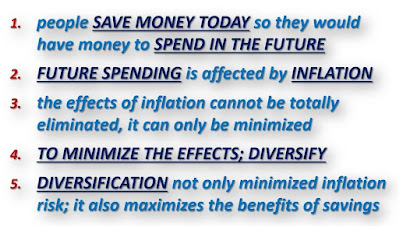
Write your advocacy statement, this will be your guide every time you have the opportunity to advocate to people, let me share my own 5-point advocacy statement


As you gain more experience in your advocacy, you will notice that you would be able to expand the scope of discussion per advocacy point, this would make you more compelling and effective, practice till you can already say it from the heart 

all the best my fellow advisors!

#acgadvice